Showing posts with label machine safety. Show all posts

Guidance for Light Curtains & Laser Scanners


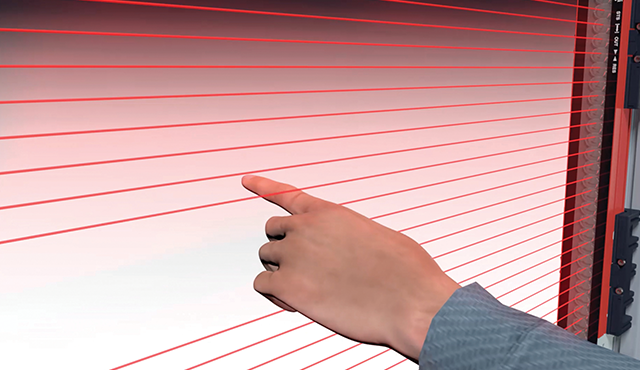
The most misapplied safety devices in the industry are light curtains and laser scanners, common issues with installations include:
  1. Application not suitable for light curtain/scanner, eg; the machine ejects parts, the machine has a long stopping time, environmental influences
  2. Light curtain placed too close to the hazard – Insufficient safety distance 
  3. Scanner safety field size is too small – Insufficient safety distance 
  4. Stopping performance monitoring not provided when it should be
  5. Muting sensors not mounted correctly
In the past, it hasn’t been easy for installers/designers to find guidance on all these topics in the one reference. We have had AS 4024.2801 in Australia since 2008, but this standard only provided sufficient guidance for safety distance calculation which addressed issues 2 and 3 from the above list.
Guidance is now at hand with the new standard AS 4024.2802:2017 being introduced. This standard provides information on all aspects of designing/installing presence sensing system such as light curtains and laser scanners.

AS 4024.2802:2017 covers safety distance calculation to address issues 2 and 3 in the above list, but it does a lot more as well.

It also provides an explanation of how to ensure the application is suitable for presence sensing devices, this guidance can help address issue 1 from the above list.

Issue 5 a major problem in the industry, it is common to see muting sensors mounted incorrectly and this increases the risk of operators inadvertently muting the light curtain and being exposed to hazards. AS 4024.2802:2017 has information on all common muting configurations and provides clear instructions on how the sensors are mounted and the timing sequence of the muting operation.
Issue 4 reflects the fact that many designers/installers aren’t aware of the requirement of stopping performance monitoring. If the light curtain/scanner is used as a trip device then the safety distance is integral to ensure the risk is controlled. If the machine’s stopping time is subject to deterioration (eg: brake wear) then the stopping time of the machine should be monitored. This information can be used to schedule preventative maintenance to ensure the safety risk is controlled and reduce unexpected downtime.

If you design/install or maintain presence sensing systems, such as light curtains or laser scanners, I recommend referencing the new AS 4024.2802:2017 standard.

Published: 8 February 2018

How do you future-proof your safety systems?


Looking through machine safety standards there is plenty of guidance for the early phases of machine safety system life cycles, by this I mean you can find good guidance to explain the following activities:
  • Select the required integrity level; CAT/PL/SIL
  • Design the safety system
  • Verify the system design
  • Validate the safety system
But what guidance is available for the operation phase of the safety system? Safety systems can be operational for 10 to 20 years, sometimes even longer! Is it reasonable to expect application parameters won't change the requirements of the safety system over that extended period of time?

Requirements can change dramatically over the life of a safety system for example here are some parameters that could affect the suitability of the current safety system:
  • The uses of the machine 
  • Speed of throughput
  • Frequency/duration of safety demands on the system
  • Stopping times of the equipment
The need to design systems to take consideration of the above changes is becoming more prevalent. Functional safety standards such as AS 62061 mention these factors as prompters for safety system modification, but how can you reliably identify these parameter changes?

Relying on manual monitoring of the safety system parameters causes extra work and is susceptible to human complacency/error.

With the ability to have high levels of data sharing from modern safety systems to standard control systems, it is possible to create this parameter checking as an automated function of the control system. Thus if the use of the machine is changed in a way that effects the safety system's suitability, this will be flagged by the control system and initiate the appropriate modification process.

The most common example of the above concept is Stopping Performance Monitoring (SPM), which is a requirement out of IEC/TS 62046. SPM should be performed when presence sensing systems such as light curtains, safety mats or laser scanners are used as a trip device and the stopping performance of the machine can be subject to deterioration, due to wear of brakes, valves, etc. SPM could be achieved by the machine control system monitoring the stopping performance of the machine and comparing this result to the calculated stopping time used for the safety distance calculation of the presence sensing system. Once the calculated stopping time is exceeded the control system could initiate a safety stop, provide information to the operator of this condition and not allow operation until the system is restored to its acceptable state.

Preventative warnings could be provided by the control system as the stopping performance approaches the calculated stopping time, thus the braking system can be repaired in upcoming scheduled maintenance. Downtime is then avoided and the level of safety is maintained.

Require more information about how modern safety systems with increased integration can assist? 

Craig may be able to assist you with the above mentioned issues, so please reach out via email - cimrie@nhp.com.au.

Craig has been a Safety Specialist with NHP Electrical Engineering Products since 2007. He is also a committee member at Standards Australia and is a TUV Rheinland certified Functional Safety engineer.
Craig Imrie


Published: 6 July 2016

New Guidance on Machinery Risk Assessments


Risk assessment on machinery is a major area of uncertainty for a large proportion of industry. It's quite common for people given the responsibility of risk assessment to be unsure of the process and fearful of being held accountable for results of the risk assessment.

While codes of practice do provide good guidance for the general process of risk assessment, they don't cover the unique challenges of machinery applications. Unfortunately, the 2006 version of the Australian Machine Safety Standards (AS 4024.1) provided only theoretical guidance for risk assessment and left many people still confused on issues such as:
  • Who should be involved in the process of risk assessment?
  • Systematic methods to identify hazards on the equipment
  • What risk estimation tools are available and how do they work?
  • What does documentation of risk assessment actually looks like?
Guidance is now available in the 2014 revision of Australian Machine Safety Standards (AS 4024.1). A new standard, AS 4024.1303:2014, has been created, which provides practical guidance on risk assessment for machinery.

This standard gives detailed information on how to set-up and prepare for a risk assessment. Advice is provided on who should be part of the team and what information should be collected to prepare for the risk assessment.

The standard also explains systematic approaches for hazard identification. For example, the top-down approach starts with defining the hazardous situations of a machine and then analyzing the hazard zones.

One of the major improvements with this standard is the information that is provided for risk estimation. This standard now explains various risk estimation tools such as Risk Matrix, Risk Graphs, Numerical Scoring and Hybrid Tools.

If you are confused about how the process is actually implemented and what the documentation looks like then Annex A of AS 4024.1303:2014 should provide some answers. This Annex explains step by step the risk assessment process carried out on a molding machine, it also shows all the documentation created during this process and explains what risk reduction measures were used.

With this new standard, AS 4024.1303:2014, you have access to information to help you facilitate risk assessments on your machinery. If you would still like assistance with the risk assessment process contact NHP's customer service team or contact your NHP sales representative.


Published: 23 June 2015

What did Australian Standards get wrong with AS/NZS 4024.1:2014?


If you're not aware, AS/NZS 4024.1 series of machine safety standards was revised late last year. In this revision most of the parts were revised, some were unchanged, some new parts were added and some parts were removed. If you want more information on what's revised, unchanged, new and removed check out this previous NHP blog topic: New Revision of AS 4024.1 Series of Machinery Safety Standards.

The 2014 dated parts of the series are "direct text adoptions" of international standards. This is confirmed by looking at the first page of each part, the adopted international standard is printed below the AS/NZS title. In figure 1 we can see that AS/NZS 4024.1602:2014 is a direct text adoption of ISO 14119:2013.
Fig 1. Part title, appears in top right corner on the first page of the part
OK, so you're thinking what's the big deal about direct text adoption?


Direct text adoption means that nothing can be changed from the international standard's wording, even references. So if AS/NZS 4024.1602:2014 is referencing a clause from AS/NZS 4024.1503:2014, the reference will appear as the international standard, ISO 13849-1:2006. This obviously makes the series a little difficult to use. Assistance can be found in the "Preface" section of each part, which will list the international standards that are referenced and will show the equivalent AS/NZ 4024 part. There is also a cross reference list available in Appendix B of the application guide, AS/NZS 4024.1100:2014.

In the previous version of the AS 4024.1 series, the parts were based on international standards but some changes were allowed. In this series the references were changed from international standards to the relevant AS 4024.1 part. As mentioned previously some parts of the series have been unchanged in the 2014 revision, for example AS 4024.1501-2006. Thus this standard still has references to clauses and parts from the 2006 version.

For example AS 4024.1501-2006 references standards AS 4024.1202 and AS 4024.1301, both of these standards are now superseded by AS/NZS 4024.1201:2014 and no longer exist in the AS 4024.1 series. So be aware of this issue when using any of the 2006 version parts of AS/NZS 4024.1:2014

Hopefully this blog topic can help you avoid this gotcha when using AS/NZS 4024.1:2014.

Have you come across anything strange with this series? Or do you have some useful hints and tips? If so please share in the comments section.


Published: 23 April 2015